
The Spin Feels Personal. The Math Says Otherwise
You tap Spin, the reels start to dance, and a result lands like it was waiting for you. It wasn’t. In that split second, the game grabbed a random number, turned it into reel stops, checked the rules, and then showed you the outcome with a bit of theater.

That’s the point of online slot randomness. It doesn’t mean a win is “coming soon.” It means each spin is a fresh event, with no memory and no payback plan.
The honest part, the part that matters, is this: licensed slots don’t get to “wing it.” Regulators and independent testing labs audit the random number generator (RNG) setup, then certify it before a game can run for real money in many markets. Certified RNG isn’t hype, it’s the guardrail.
What an RNG is, and why it runs nonstop in online slots
An RNG, random number generator, is the slot’s heartbeat. It’s software (or a secured module in the game system) that spits out numbers at high speed, over and over, whether anyone is playing or not. Think of it like a fast metronome that never stops clicking.
When you press Spin, the game doesn’t start “thinking” from scratch. It captures the next value from that nonstop stream and uses it to determine the outcome. That’s why the timing myths don’t hold up. The numbers were already pouring out. Your spin just grabbed one.
This setup also explains the big rule that casinos hate arguing about because it ruins so many beliefs: each spin is independent. The game doesn’t care what happened five seconds ago. It doesn’t care that you lost ten in a row. It doesn’t get sentimental after a dry spell. It just takes a number and follows the math.
Most online slots use a PRNG, a pseudo-random number generator. That sounds fake, but it’s the industry standard in regulated real-money games because it’s fast, stable, and testable. A PRNG starts from a “seed,” a starting value, then runs it through a mathematical process that produces outputs that are unpredictable in practice. Strong seeding and controlled re-seeding help stop patterns from forming or being guessed.
True random number generators (TRNGs) can exist, too. They use physical noise sources instead of pure math. You’ll hear about them in high-security contexts, but they’re less common for everyday slot gameplay. Real-money slot systems usually use PRNGs because regulators and labs can test them rigorously and certify the results.
PRNG vs true random, what most real money slots actually use
PRNG wins on practicality. It runs fast, it behaves consistently, and it can be audited. Testing labs can run statistical checks, review their implementation, and confirm that it meets fairness standards.
There’s also a simple takeaway that saves people money: you can’t “time” the button press to catch a better moment. The system is generating outputs constantly. Your tap doesn’t steer the river; it just scoops a cup of water.
Why a slot can’t be “due” if every spin is independent
People love the idea of a hot machine. Or a cold one. Or a machine that’s “due.” It feels like street wisdom. It also breaks the moment you accept independence.
A clean analogy is coin flips. Ten heads in a row feels like something’s going on. The next flip is still 50/50. Random systems produce streaks, long ones, ugly ones, the kind that feels personal. That’s normal variance, not a signal.
Slots are the same. The RNG has no memory, so the game can’t build up pressure and “release” a win later. It just keeps producing fresh outcomes, again and again, even when the results seem to tell a story.
From random number to reel symbols, what happens after you press Spin
The reels you see are the show. The decision happens before the show finishes.
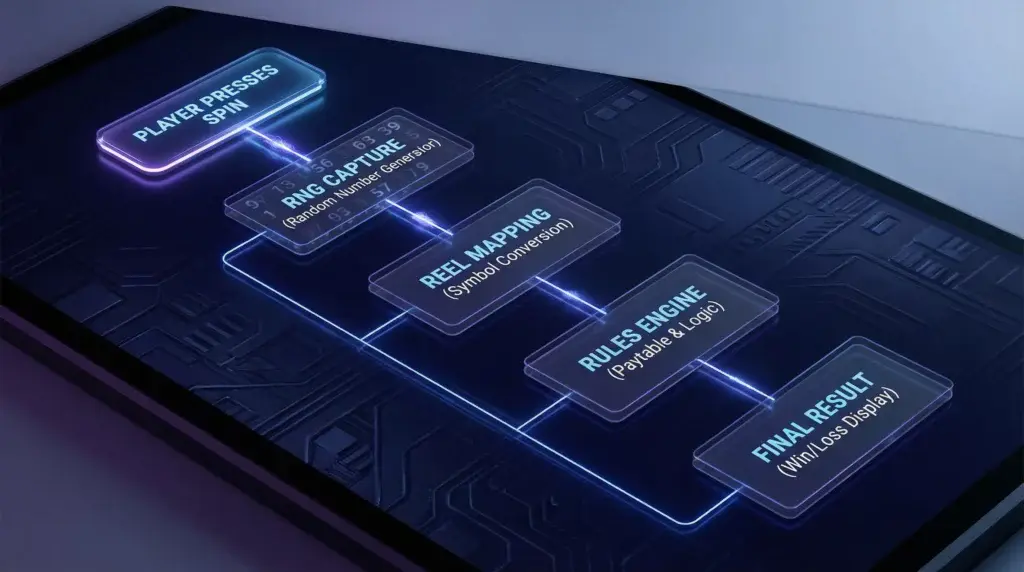
Behind most online slots is a simple lifecycle. It’s not mystical. It’s more like a transaction being processed, fast and logged.
- The game receives your spin request (bet size, lines or ways, session details).
- The secure game system captures one or more RNG outputs at that moment.
- Those numbers are mapped to stop positions on each reel (or to an outcome model).
- The rules engine evaluates the result (paylines or ways, wild rules, scatter rules, multipliers).
- If a bonus triggers, the bonus resolves (often with extra RNG calls and feature rules).
- The result is returned to you and recorded in logs for audits and disputes.
That’s the spine of it. The animation is just the curtain call.
This is also where people get confused by “virtual reels.” Many slots don’t treat each symbol as equally likely. They use reel strips behind the scenes, lists of symbols where common symbols appear more often than rare ones. That weighting is how a game controls hit rate, bonus frequency, and volatility while keeping the selection itself random.
And yes, bonuses and jackpots often add more RNG moments. A Hold and Spin feature might trigger on one spin; each respin within the feature is a separate random event. A progressive jackpot may have eligibility rules layered on top, depending on the game and operator setup. If you want a concrete example of how that looks in a well-known title, this Dragon Link slot machine guide breaks down features, jackpots, and why betting rules can vary by venue.
Reel mapping and virtual reels, why the symbols are “weighted.”
Here’s the clean version: the RNG doesn’t usually pick “a cherry” or “a dragon.” It selects a number that points to a position on a hidden reel strip.
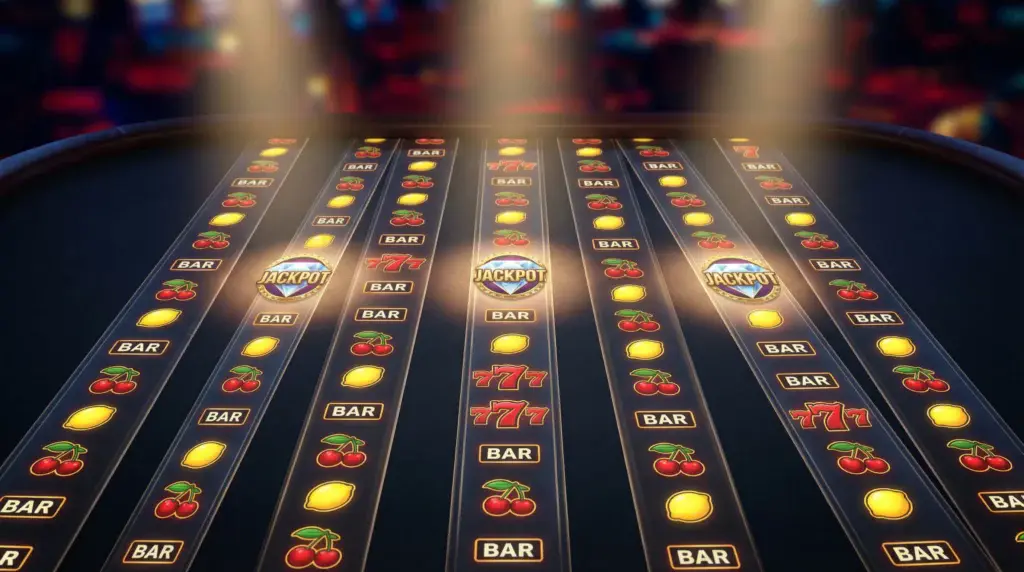
Those strips repeat symbols. A low-value symbol may appear multiple times. A rare jackpot symbol might show up once or a few times. That’s weighting, and it’s how designers control the feel of the game. More frequent small hits, fewer but bigger swings, or the other way around.
This also explains “near misses.” When you see two scatters and the third just above the window, it’s tempting to think the game dangled it on purpose. Most of the time, it’s just the displayed slice of the reel strip around the stop position. It looks dramatic because it is dramatic. It isn’t proof of a machine plotting against you.
RNG vs RTP, why both can be true at the same time
RNG decides what happens on this spin. RTP (return to player) describes the long-run average payout over a large number of spins.
They’re not enemies. They’re different layers.
A 96 percent RTP slot isn’t promising you get $96 back from $100 tonight. It’s saying that, across a large volume, the math model returns about that amount on average. Your session can land above it, below it, or even way below it. The RNG keeps each spin unpredictable, while the RTP reflects the long-term payout pattern.
How you can tell whether a slot’s RNG is trustworthy
A player can’t inspect the RNG code. That’s fine. The real check is whether the game operates within a system that is audited, certified, and monitored.
Independent labs such as eCOGRA, iTech Labs, and GLI test RNG behavior and review implementations. They run large statistical test suites and verify the game behaves as designed, including how outcomes are produced and recorded. On the regulatory side, major licensing bodies such as the UK Gambling Commission, the Malta Gaming Authority, and US state regulators (New Jersey is a well-known example) require certified randomness for licensed operators.
In plain terms, trustworthy slots tend to show a few green flags. The site lists a valid license, shows certification details or testing references, publishes RTP or makes it accessible in the rules, and doesn’t hide behind vague language. Shady setups keep ownership unclear, dodge licensing questions, and push “guaranteed win” talk.
One more reality check, because it saves bankrolls: no strategy beats RNG. The control you actually have is boring but effective: budget limits, session limits, and playing for entertainment, not rent money.
Myths that won’t help you win, but can cost you money
- “Slots pay more at night.” RNG output doesn’t care about clocks or crowds. Each spin stands alone.
- “Bigger bets improve your odds.” Most of the time, bet size changes payout size, not the random selection. Some games tie certain jackpots to minimum bets, but that’s a stated rule, not the RNG bending for you.
- “You can spot patterns.” Streaks look like patterns because humans are built to see them. A properly implemented RNG is designed to resist prediction.
The Final Spin
Online slots generated random numbers the same way, over and over: the RNG ran nonstop, your spin captured a value, mapping turned it into reel stops, rules and bonuses resolved the outcome, and the game logged it before you even saw the reels finish. Clean, fast, repeatable.
The smart play is simple. Stick to licensed, certified games, treat RTP like long-run math, not a refund policy, and drop the “due” mindset. Random doesn’t owe anybody a win. Set limits, keep your expectations sharp, and let the spin be what it is, a paid roll of the dice.