
You’vemay have heard about slot RTP and volatility and probably even seen it: you pick a slot with “96% RTP,” spin for 10 minutes, and your balance still drops like a rock. Then another day, the same kind of game seems to “treat you right” for a while. That whiplash is normal.
RTP is a long-run average, usually modeled over huge spin counts (often in the millions). Variance explains why your short session can look nothing like that average. In this guide, I’ll break down RTP, variance (also called volatility), and hit rate in plain English, so you can pick games that fit your budget and your patience.
One more helpful baseline: most real-money online slots tend to sit around 94% to 97% RTP, and many modern games come in multiple RTP settings (the casino chooses one allowed in its region).
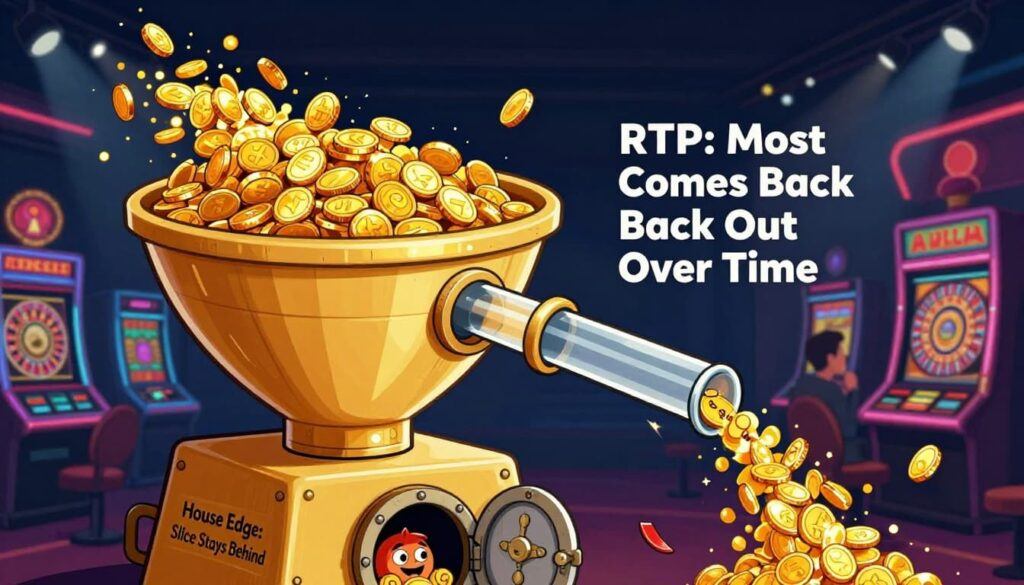
RTP explained in plain English, what that percent really means
RTP (Return to Player) is the theoretical share of total wagers a slot pays back over the long run. If a game is listed at 96% RTP, the math model says that across an enormous number of spins, the game returns about $96 for every $100 wagered (across all players and all spins), on average.
That also means the “house edge” is the leftover part: 100% minus RTP. So a 96% RTP slot has roughly a 4% house edge in the long run. It’s not a fee you pay each spin like a tax, it’s more like a long-term drift.
And because slots use an RNG (random number generator), each spin is independent. The reels don’t remember your last 50 spins. Your session can run hot or cold for a long time before that long-run average starts to show up. This guide to Understanding RTP And Variance is meant to help you read slot stats without overthinking them.
Understanding RTP And Variance in short sessions (why 200 spins means little)
Picture two players doing 200 spins on the same 96% RTP slot. One triggers a bonus early and ends up ahead. The other misses features and burns through a session bankroll fast. Same RTP, totally different stories.
That’s because RTP needs a massive sample to settle down. A few hundred spins is basically a “weather report,” not a climate chart. The short run is noisy, and variance drives most of what you feel.
If you only remember one thing: RTP describes the long run, but your actual session is mostly variance plus randomness.
The hidden detail, some slots have more than one RTP setting
A lot of players miss this. Many modern slots ship with several approved RTP configurations (for example 96%, 94%, or 92%) while keeping the same general volatility style. Casinos then select a setting that fits local rules and their own menu of options.
Where do you actually check?
- The game’s info screen or paytable
- A “help” or “settings” panel inside the slot
- The casino’s game details page (sometimes)
If you want a real example of why this matters, this guide on Dragon Link explains how RTP can vary by casino, jurisdiction, and setup.
Variance (volatility) is what makes slots feel “swingy”
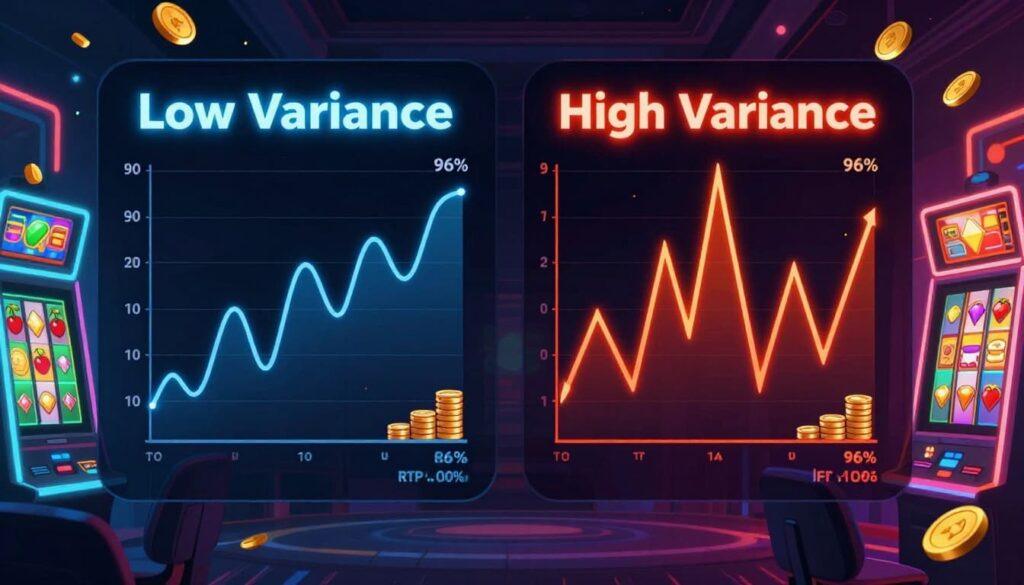
Variance measures how widely outcomes can swing around the average. In slot terms, it’s the difference between:
- Low variance: more frequent, smaller wins, fewer brutal droughts
- High variance: longer losing stretches, but occasional bigger hits
Here’s the part that surprises people: two slots can share the same RTP and still feel completely different. One game might “pay” often in tiny chunks, while another stores most of its RTP inside rare bonuses or big multipliers.
A simple way to compare the feel:
| Volatility tier | What you notice in a session | Typical emotional pressure |
|---|---|---|
| Low | Frequent small hits, slower bankroll drop | Lower, easier to stay calm |
| Medium | Mix of quiet stretches and decent pops | Moderate, depends on bonus timing |
| High | Lots of dead spins, then sudden spikes | Higher, easier to chase |
Low, medium, and high variance, what you’ll notice while playing
Low variance tends to give more “feedback.” You might lose overall, but you see wins often enough to stay engaged. That’s why these games can feel friendlier for smaller budgets.
Medium variance sits in the middle. You’ll still get dry runs, but they usually don’t feel endless. When features land, they can move the balance in a noticeable way.
High variance is a different mood. You can go long stretches with nothing but tiny line hits, then suddenly hit a feature that changes the whole session. Some people love that. Others get irritated fast (I do, on the wrong day).
Try SpinQuest Take a quick lookHit rate connects the dots between variance and your experience
Hit rate is simply how often any win happens, even if it’s tiny. It doesn’t mean you profited on the spin, it just means the slot returned something.
As a loose guide, low volatility slots often land around a 25% to 35% hit rate. High volatility games can fall well below that because they trade frequent wins for fewer, larger feature moments.
A quick way to picture it over 200 spins:
- At a 30% hit rate, you’d expect about 60 winning spins on average, many of them small.
- At a 15% hit rate, you’d expect about 30 wins, but more of the value may be packed into rare bonus rounds.
That’s why a high variance slot can feel “dead” even if the RTP looks fine on paper.
Understanding RTP And Variance when picking a slot
RTP is your cost baseline, variance is the ride. I treat RTP like a first filter, then I use volatility to match what I want that day.
In February 2026, many licensed casinos still list most slots in the mid-90s RTP range, and you’ll see plenty of titles around 96% (with higher-RTP outliers too). Still, the difference between 94% and 97% matters over time, so I usually prefer 96%+ when I can find it, then I choose variance based on mood and bankroll.
Here’s a clean example. Two slots both show 96% RTP:
- Slot A pays 1x to 2x your bet fairly often.
- Slot B pays 50x to 1,000x rarely.
Your long-run expectation is similar, but your short-term experience is nothing alike.
A quick way to spot high variance before you spin
You can often sense volatility without a spreadsheet. I look for a few clues:
- Maximum win size: numbers like 5,000x or 10,000x often hint at higher variance.
- Where the payout lives: if most of the excitement sits inside bonus rounds, base play may be quiet.
- Bonus buy and progressives: these mechanics tend to concentrate value into rare events, which boosts short-term swings even if RTP stays similar.
None of this guarantees anything, it just helps you avoid surprises.
Bet sizing and session rules that actually fit the math
First, a small piece of math that keeps expectations honest:
Expected loss per spin (long run) = bet size × (1 − RTP)
So if you bet $10 per spin on a 96% RTP slot, the long-run expected loss is about $10 × 0.04 = $0.40 per spin. Over 200 spins, that’s about $80 expected loss, in theory. Your real result can be way above or below that because variance dominates short sessions.
That’s why I like simple guardrails:
- Low variance: you can usually survive with smaller cushions, and sessions feel steadier.
- High variance: give yourself more room, or shorten the session, because droughts happen.
I also set a stop-loss, a profit target, and a time limit. Not because it changes odds, but because it stops the classic “just one more” spiral. If you’re playing with bonuses, wagering rules add another layer of risk and time, this guide “Casino Wagering Requirements,” helps you do the math quickly.
Common RTP and volatility myths that lead to bad decisions
Bad assumptions cost more than bad luck. A couple of these myths show up constantly.
Myth: A higher RTP means you’ll win more often
Higher RTP improves long-run payback, but it doesn’t promise frequent wins. Frequency is more about volatility and hit rate. A 98% RTP game can still feel brutal if it’s built to pay big, rarely.
On the flip side, a lower variance slot with average RTP can feel “nicer” in a short session because it hits more often.
Myth: After a cold streak, a win is “due”
Slots don’t have memory. The RNG doesn’t care that you’ve had 40 losing spins. The next spin is still random.
Chasing losses by raising bets can wreck a bankroll fast, especially on high-variance games. I’ve done it before, and it’s never a proud moment. If gambling stops feeling fun, step away and reset. If it’s affecting someone close to you, this guide on talking to loved ones about gambling concerns is solid and practical.
This Articles RTP
RTP tells you the long-run payback, variance tells you how wild the ride can get, and hit rate helps you picture how often wins show up. Before you play, check the RTP setting, look at volatility cues, and pick a bet size that matches your comfort with swings. Most of all, set limits early, because it’s hard to invent discipline mid-session. If it stops being enjoyable, that’s your signal to quit for the day.